
The 5 Best Wine Decanters (Reviews For 2026)


For serious wine aficionados, decanting isn’t just another step in the process – it’s a ritual, celebrating the unique combination of flavors in each bottle.
However, even if you’re a newbie, using a decanter is a wonderful tool to really bring out all the slightest nuances of each wine so you can enjoy it to its fullest extent. Of course, they’re not a one-size-fits-all kind of product, with so many different types, materials, and functions!
I’m here to ensure you select the one just right for you, bringing you the 5 top wine decanters on the market today. Let’s jump right in!
Be sure to see our reviews of Wine Aerators, Wine Chillers and Red Wine Glasses.
ChoiceWineries.com is reader-supported. When you buy through the links on our site, we may earn an affiliate commission. Visit our disclaimer page for more information.
Best Wine Carafes & Decanters
| Schott Zwiesel Tritan Crystal Pure Collection Carafe Decanter | RIEDEL Ultra Decanter | Ullo Wine Purifier with Hand Blown Decanter | |
|---|---|---|---|
 |  | | |
 |  |  | |
| Wine Type: | Red Wine (White Wine decanter available) | Red Wine | Red, White, and Rosé |
| Material: | Crystal Glass | Hand blown glass | Glass |
| Capacity: | 25 oz. | 43 oz. | 25 oz. |
| Weight: | 1 Pound | 1.3 Pounds | 3.69 Pounds |
Quick Answer: The 5 Best Rated Wine Decanters For 2026
- Schott Zwiesel Tritan Crystal Pure Collection Carafe Decanter
- RIEDEL Ultra Decanter
- Ullo Wine Purifier with Hand Blown Decanter
- Ravenscroft Crystal Large Wine Decanter, Crafted in Europe
- Wine Decanter Built-in Aerator Pourer Wine Carafe
Wine Decanter Reviews
1. Schott Zwiesel Tritan Crystal Pure Collection Carafe Decanter
- Wine Type: Red Wine (White Wine decanter available)
- Material: Crystal Glass
- Capacity: 25 oz.
- Weight: 1 Pound
If there’s one accessory every wine lover needs to boost their sipping experience, it’s a decanter that melds form and function seamlessly.
I bring you the Schott Zwiesel Tritan Crystal Pure Collection Carafe Decanter, which brings together sophistication, practicality, and a visually aesthetic, ultra-modern design.
Made from patented Tritan crystal, it’s much more than appearance, with its scratch-resistant material and durability meant to last for countless parties or tastings.
I easily fell in love with this decanter with its wide, sloping base and precisely tapered neck that just gives an appearance of a kind of fine art. It looks fantastic on any bar or tabletop, instantly adding to the elegance factor of a room.
However, the shape also serves to ensure optimal aeration, allowing your red wine to breathe and release its intricate bouquet the way it was intended to. Meanwhile, the thin neck makes pouring easy, smooth, and virtually spill-free, so you don’t waste a drop of your favorite Cabernet Sauvignon or Pinot Noir.
The minimalist silhouette and crystal-clear brilliance have made it an eye-catcher on my bar cart, hopefully suggesting to my guests that I more or less know about wine! It’s super easy to retain its sparkling clarity, too – just rinse it after you’re done and you’re done!
It’s neither the cheapest nor most expensive red wine decanter out there, but for the incredible build quality, gorgeous looks, smart design, and convenience, this really is one of those “biggest bang for your buck” items that every wine drinker should consider adding to their arsenal.
2. RIEDEL Ultra Decanter
- Wine Type: Red Wine
- Material: Hand blown glass
- Capacity: 43 oz.
- Weight: 1.3 Pounds
If you’re someone who sees wine as far much more than just a “drink”, the RIEDEL Ultra Decanter is an indispensable tool to have in your home. This is not just your average wine vessel – this is a masterpiece of Austrian craftsmanship designed to amplify the experience of each pour.
This is yet another absolutely gorgeous model made for drawing attention but also making sure your wine tastes as incredible as possible. The fine glass body was mouth-blown in Austria by expert glassmakers, with a clean, minimalist silhouette that looks like it belongs in an art gallery.
The elongated neck and broad base are as functional as they are elegant, ensuring maximum surface area exposure so your favorite reds aerate fully. You’ll have a bouquet that blossoms, flavors that flourish, and tannins that soften nicely – perfect for even beginner wine drinkers!
Crafted from fine crystal, the decanter boasts an ethereal brilliance that elevates any dining table or bar setup. While I typically appreciate lightweight bar accessories, when it comes to decanters, I prefer one that feels substantial yet easy to handle.
That’s exactly what you get here, with effortless pouring, thanks to its perfectly balanced shape and lack of excess adornment. It’s straightforward and easy to clean, simply requiring a good rinse after use to maintain its gleaming clarity.
With a generous 43-ounce capacity, it comfortably accommodates a full bottle of wine, making it perfect for intimate dinners, a quiet evening on your own, or fun celebrations!
This is a model that will make you realize that not every decanter is the same – especially in the quality of the glass and the difference in the taste of your wine.
3. Ullo Wine Purifier with Hand Blown Decanter
- Wine Type: Red, White, and Rosé
- Material: Glass
- Capacity: 25 oz.
- Weight: 3.69 Pounds
This next model takes the wine experience a step further, with their smart, science-backed system that selectively removes sulfites while preserving your wine’s character.
The Ullo Wine Purifier with Hand Blown Decanter is a sleek design enhanced with cutting-edge functionality so you’ll enjoy your favorite red, white, or rosé in its purest form, unmasked by preservatives.
Whether you’re sensitive to sulfites or simply enjoy wine in its purest form, the Ullo is sure to offer each glass just as the winemaker intended.
Beyond the technology, the decanter itself is absolutely stunning – made from hand-blown, lead-free glass, it commands attention with its sophisticated design that will go well with any bar setup or table.
The wide base helps encourage aeration, allowing your wine to breathe while enhancing their flavors and bouquet. I’m not sure if it was purposefully designed this way, but the ease of use and sturdiness does feel almost “ergonomic”, making it much easier to pour without spilling or drips.
The purifier nestles seamlessly right on top of the decanter with its “modular” design, filtering all of the bad stuff out as you pour – no extra steps required. I admittedly had my doubts, but wow – you really will feel hangovers much less severely, if at all.
It doesn’t alter the wine’s natural chemistry, though the first time I used the filter on my wine, I swear I perceived new flavor notes!
As if all that wasn’t already enough, the Ullo easily disassembles in mere seconds, and is dishwasher safe so you can just rinse them off or pop them in the machine!
4. Ravenscroft Crystal Large Wine Decanter

- Wine Type: Red Wine
- Material: Crystal
- Capacity: 66 oz.
- Weight: 5 lbs.
I know that every single decanter I’ve covered so far has been visually attractive, but wow – this next one is truly a breathtaking piece of art.
The Ravenscroft Crystal Large Wine Decanter, crafted in Europe is a transformative addition to your wine setup. If you’re looking for a decanter with a generous capacity ideal for dinner parties or gatherings with a group of people, this should be at the top of your list.
Placing a specific focus on optimal aeration, it’s a fantastic addition to any home or bar! Handcrafted from lead-free crystal, it’s been carefully made with both function and elegance in mind, catering to the discerning tastes of casual and experienced sippers.
It’s clear that its been hand-blown as there were a couple of little, tiny bubbles that otherwise would go unnoticed if you don’t specifically scan for them. However, I personally liked this as it makes it that much more unique and personalized – no impersonal, machine formation!
The heavy, spherical crystal stopper is absolutely gorgeous, ground to sit in the neck of the decanter seamlessly, creating a fantastic seal that’s superior to cork or rubber, which over time will break down.
The shape does a great job of taming bold tannins while bringing out the full flavor bouquet of your favorite red. The sleek, curved silhouette isn’t just about aesthetics, either – it’s a thoughtfully engineered pourer, ensuring each drop lands in your glass!
Free from heavy metals and other impurities, it preserves the integrity of your wine without introducing off-flavors, maintaining the authentic flavors that the winemaker intended on.
The weight reminds you that it’s a quality piece made to last, though is still light enough that you’ll expertly handle the wine pouring without wobbliness.
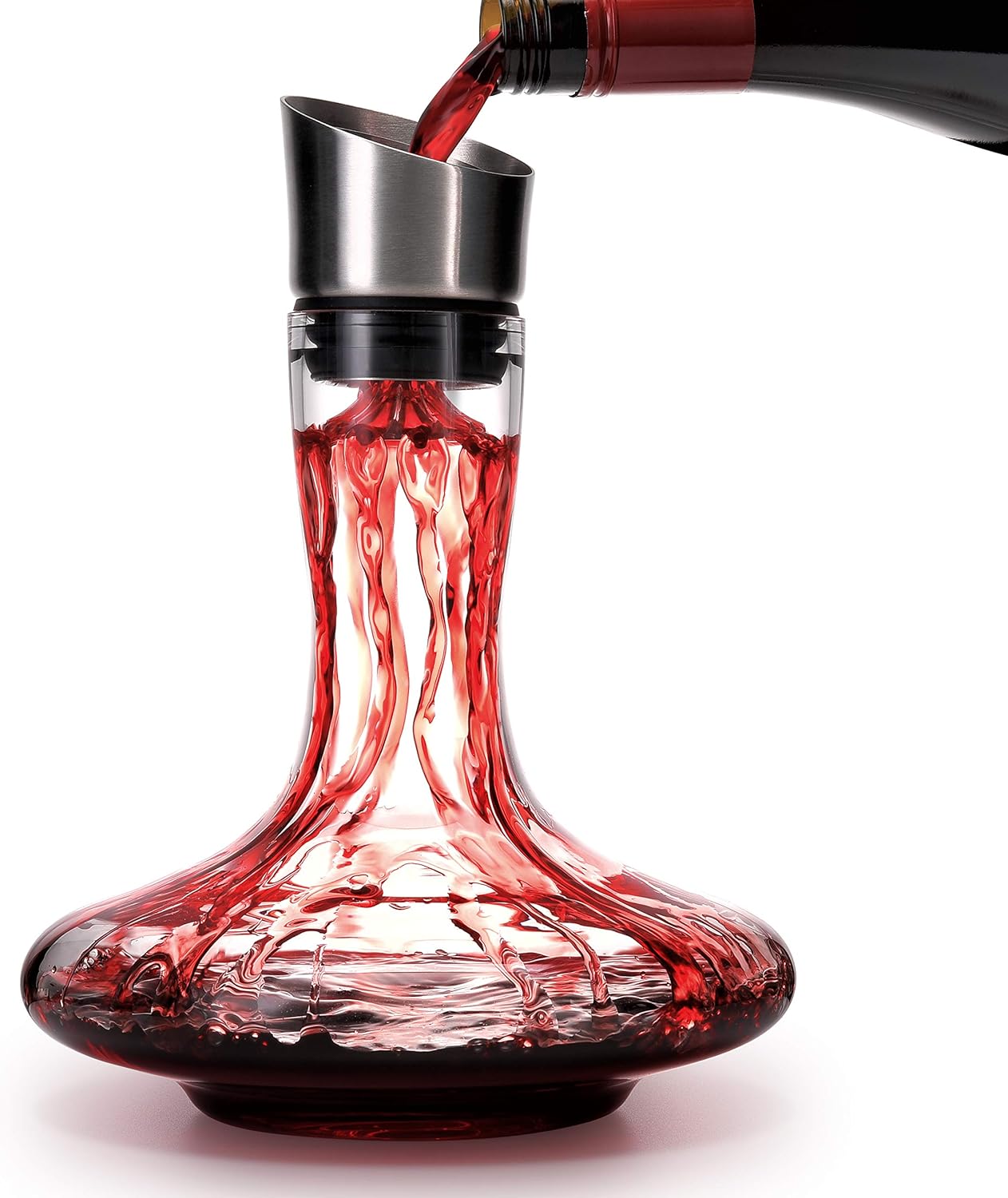
5. Wine Decanter Built-in Aerator Pourer Wine Carafe
- Wine Type: Red Wine
- Material: Crystal
- Capacity: 750 milliliters
- Weight: 1.6 lbs.
Last but certainly not least, is the Wine Decanter Built-in Aerator Pourer Wine Carafe, which should be your go-to if you’re looking for a quality product on a tight budget.
There are a ton of affordable decanters out there, but unfortunately, many of them don’t really do much in terms of aeration – they more just assist with pouring in a more refined way.
That isn’t the case with this little gem, though – I am constantly impressed by the quality you get here, from its appearance to its functionality.
Unlock the full potential of your red wine without breaking the bank, with this compact, handheld tool that takes the guesswork out of aeration and brings back the rich aromas and soft textures of a properly decanted bottle.
No need to wait, because you’ll get to enjoy your favorite Merlot or prized vintage at dinner or sip on a casual weeknight nearly immediately. The multi-stage aeration system infuses oxygen into your wine as you pour, lessening harsh tannins while improving flavor complexity.
The elegant spout fits snugly onto any bottle, ensuring a spill-free experience, while the ergonomic grip makes it easy to use. I’m in love with the beautiful waterfall bottleneck design, along with the decanting device that spreads the wine a full 360 degrees over the entire glass body.
Watching it happen is absolutely fascinating, and I love doing it for guests who’ve never seen anything like it before serving them!
The 100% high-quality, lead-free crystal is durable yet beautiful, complete with a bottle stopper made of food-grade stainless steel to keep it preserved nicely. It serves as the perfect gift for any wine lover, though I am sure you’ll enjoy it for yourself, too!
A Guide to Wine Decanters
A young Barolo comes out of the bottle like a closed fist. Pour it straight into a glass and you get tight cherry and a wall of tannin that has not decided what to do yet.
Give it an hour in a decanter and the same wine starts to loosen. That is the case for owning one, and it is a good case with a few honest limits.
Why Decant
A decanter does two jobs. It separates wine from sediment, and it gives wine air.
Only the second job is up for debate.
Sediment
Older reds drop a gritty residue as they age, and it tastes bitter and dusty in a glass. A decanter lets you pour the clear wine off it.
Matt Kramer, writing in Wine Spectator, calls sediment a legitimate reason to decant but a pretty rare one these days. He is right.
A bottle drunk within a few years of release rarely has any to leave behind.
Air
Oxygen changes wine, and a decanter speeds that up. Andrew Waterhouse, a California enology professor, says in Smithsonian that air lets unpleasant volatile compounds escape from expensive young reds that taste closed.
Jim LeMar disagrees in the same piece. He says some pleasant aromas are so fragile they can vanish after a few seconds of air.
Waterhouse also says chemists have not seen tannins change after decanting. The popular idea that a decanter softens tannin is not backed by what has been measured.
Off Aromas
Kramer says air can blow off unpleasant odors from bacteria, brettanomyces and sulfides. A bottle that smells like a struck match for the first minute is often just reduced and will clear with a little time.
Air will not rescue a wine that is actually spoiled.
I treat air as a tool. I use it on wines that need it and leave the rest alone.
Which Wines Need a Decanter
Young, Structured Reds
Start with full bodied reds that are still young. Cabernet Sauvignon, Bordeaux, Barolo, Barbaresco and Syrah are the usual suspects, and Total Wine names Cabernet Sauvignon and Bordeaux among the common picks.
Total Wine suggests a minimum of 30 minutes and warns against hours and hours. Kramer says 15 minutes is plenty for most wines.
For a young Cabernet I go about 30 minutes. For a tight young Barolo I go an hour or more and taste along the way.
Old Wines
Old wine is a different animal. Stand the bottle upright for a day if you can, pour it slowly, and serve it soon after it hits the decanter.
Total Wine says older vintages need only a quick burst of oxygen. Kramer calls the danger the grandma rule, since delicate old aromas can fade fast once exposed.
A 30 year old Bordeaux can peak in the first 20 minutes and be tired by the second hour.
What to Skip
Most whites do not need a decanter, and sparkling wine never does because you lose the bubbles. Total Wine says the same.
Burgundy deserves a mention. Kramer notes that Burgundians traditionally do not decant, because they worry about dissipating the scent.
Sommeliers argue about Pinot Noir, so use judgment and taste before you commit.
Rare Bottles
Total Wine advises serving delicate wines and rare bottles straight from the bottle to the glass, unless you are an experienced connoisseur. I agree for anything you cannot replace.
Practice on a $25 bottle of the same grape first.
Decanter Shapes and Materials
Standard
Total Wine describes the standard decanter as a wide base with a tapered neck that balances sediment separation and aeration. It works for reds and whites, and it is the one to buy first.
Swan
The swan is the largest style, with a wide J shaped base. It aerates well and suits bold wines.
It is also hard to wash, so think about cleaning before you buy.
Duck
The duck looks like a teapot and pours easily. It aerates less than a swan and handles heavy sediment, which makes it a good match for old bottles.
Cornetto
The cornetto has a wide base and a long curved neck, and it suits delicate wines. Riedel makes a well known version.
Aerators
An aerator is a small beaker shaped piece that exposes wine to oxygen quickly. It earns its place when you are short on time.
Crystal or Glass
Lead crystal is heavy and chips easily at the rim. One cleaning guide reports chipping at least three decanters on the faucet.
Lead can also leach into what you store. McGill University’s Office for Science and Society says serving from a lead crystal decanter at a dinner party is fine, but alcohol should not be stored in one.
Port in lead crystal rose from about 90 to 4,000 micrograms of lead per litre in four months. The limit for drinking water is 50.
Serve from it, and pour out what is left the same night.
How to Decant
An Old Bottle
Total Wine lays out a simple method, and it is the one I follow for old bottles.
- Stand the bottle upright for a day if you can.
- Pull the cork gently and hold a light behind the neck to find the sediment. A phone flashlight does the job.
- Pour in one slow, steady stream.
- Stop when the sediment reaches the neck of the bottle.
- Serve soon.
A Young Bottle
There is no ceremony here. Pour the wine into the decanter, let it sit, and taste it along the way.
Kramer notes that large modern glasses give a wine plenty of air with a few swirls. A young bottle can also go straight into a big glass.
Hyperdecanting
Nathan Myhrvold blends wine for 30 to 60 seconds, a method he calls hyperdecanting. He says in Smithsonian that it almost invariably improves red wines.
John Kelly, a Sonoma Valley winemaker, replies that a measurable change does not mean everyone will prefer it. I will not be putting a Barolo in a blender.
Double Decanting
Kramer mentions double decanting, which means decanting a wine twice. Collectors often pour an old bottle into a decanter to leave the sediment behind, rinse the bottle, and pour the wine back in to serve it from its original bottle.
It looks fussy and it is fussy. It also keeps the label on the table, which some hosts care about.
Cleaning and Care
Rinse Early
Rinse the decanter with hot water by the next morning at the latest. Stains are far easier to remove before they dry.
Before the first use, swirl a little of the wine you plan to pour instead of tap water. The cleaning guide notes that tap water can carry chlorine.
Stains
The same guide found that a denture or coffee maker cleaning tablet, dissolved in very hot water, left no taste and made the glass brighter. Cleaning beads work best on flat bottom decanters.
Skip rice and eggshells, which can leave debris stuck at the shoulder. Skip vinegar too, since the smell can linger.
Drying
Dry the outside while the glass is still warm, using a lint free towel. Then set the decanter upside down on a rack sturdy enough to hold its weight.
No rack means propping it carefully and turning it over several times across a few days. Store it completely dry in a ventilated spot, ideally with a lid or stopper.
The Dishwasher
I keep decanters out of it. Heat and a rack full of plates are a bad combination for thin glass.
What to Buy and What It Costs
Buy a standard decanter first. It handles almost every bottle you will open.
Then check four things before you pay.
- Capacity. It should hold a full 750 ml bottle with room left over for air.
- Base. A wide, stable base keeps a full decanter from tipping.
- Bottom. Flat is easier to clean, since beads and brushes work best on a flat bottom.
- Opening. Wide enough to pour into without a funnel and without spilling.
Plain glass decanters start at roughly $25, and good mouth blown pieces climb past $100. Expensive does not mean better.
A $30 decanter and a $300 one do the same job on a young Cabernet.
Frequently Asked Questions
Do I need a decanter if I own big wine glasses?
Not always. Kramer says large modern glasses give a wine substantial air with a few swirls.
A decanter earns its place with sediment and with very young reds. Kramer also points out that it looks good on the table and keeps guests from fixating on the label.
How long should I decant red wine?
Fifteen minutes to an hour covers most bottles. Kramer says 15 minutes is enough for most wines, and Total Wine says at least 30.
Go longer for young, tannic reds and shorter for old ones. Taste as you go.
Should I decant white wine?
Usually not. Total Wine says whites typically need no decanting, though it is not a strict rule.
If you do decant a white, chill the decanter first, as Total Wine advises.
Does decanting soften tannins?
Probably not in any way a lab can measure. Waterhouse says chemists have not observed tannins changing after decanting.
What does change is the smell, as unpleasant odors blow off. That is where the real benefit lies.
What should a beginner start with?
A standard decanter that holds a full bottle. Total Wine also suggests beginners practice on younger, full bodied wines.
Save the old bottles for after you have poured a few young ones.
Effectiveness
Quality
Value
The Schott Zwiesel Tritan Crystal Pure Collection Carafe Decanter is our Editors Choice for the best wine decanter

Shayanne is a freelance writer, wine snob and marketer based in LA, California. Describing herself as a nomad, she has lived in many different cities including Boise, Idaho and Seattle, Washington as well as Guadalajara, Mexico. She is forever on the move.
Being an extremely active person, she loves to snowboard, skateboard, and ski. She enjoys sharing her love for active sports with others through her “how to” sports guides as well as food and wine reviews. Her love for wine and good food shines through every paragraph. While she travels, Shayanne loves to try new restaurants and wineries. If there is a wineries or good restaurant in your town, you will probably meet her one day.